Turn Strategy Into
Real Momentum
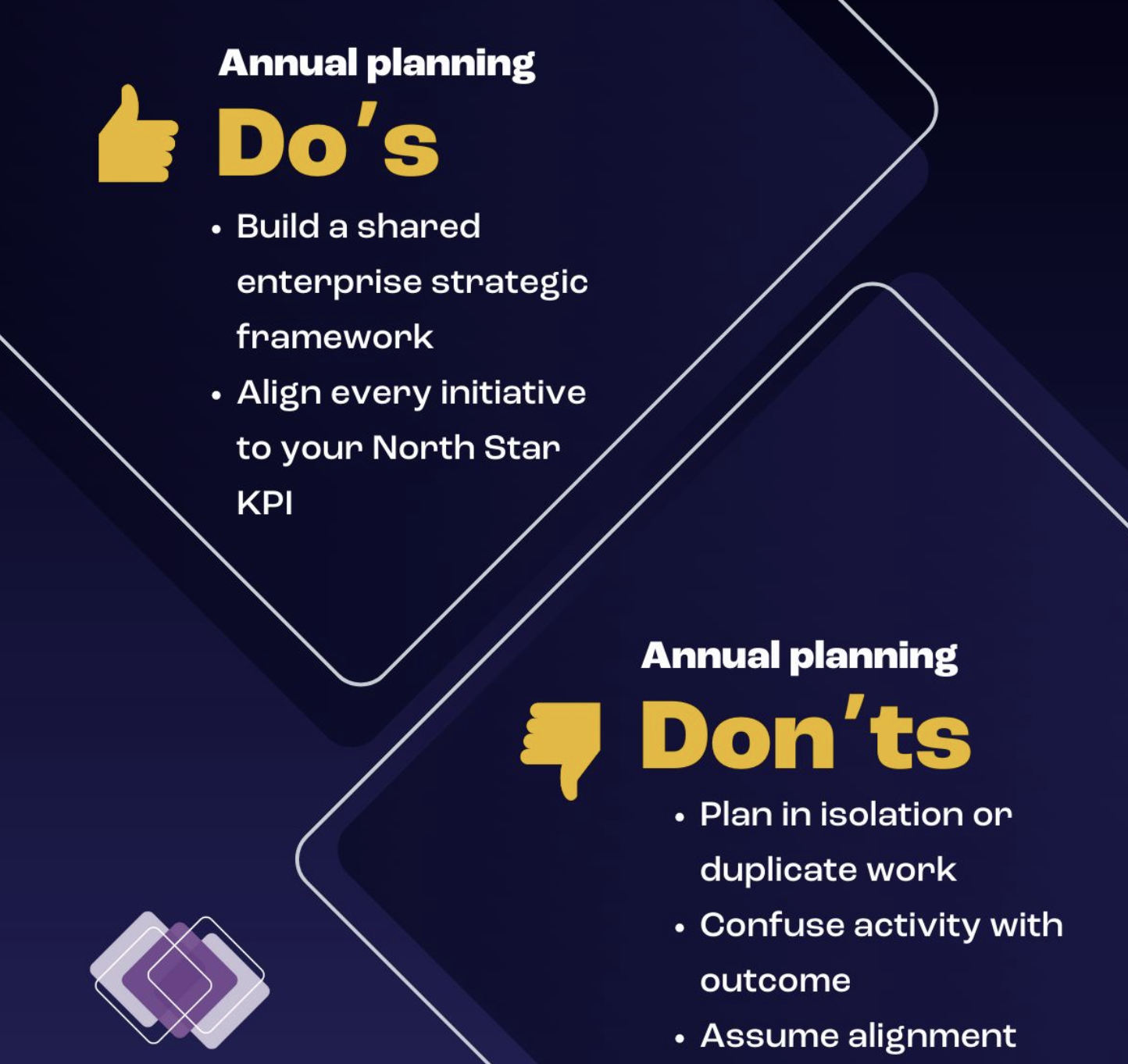
In most organizations, the problem isn’t a lack of ideas. It’s a lack of clarity, operational discipline, and—above all—leadership alignment. You don’t need another deck filled with big concepts. You need systems that translate strategy into execution and teams that move in the same direction.
If you are deep in annual planning and still struggling to get cross-functional teams aligned on priorities, you are not alone. Many high-performing organizations face this same issue, and the costs—financial and operational—add up quickly.
One of our clients came to us with a challenge we see far too often: no cohesive strategic planning process. Individual business units were operating on their own timelines, using their own frameworks, and developing plans that often contradicted or duplicated one another. Some had only short-term plans; others had none at all.
The result was predictable:
- A fragmented go-to-market approach
- Redundant work that drained resources
- Operational friction across teams
- Strategy that looked compelling in PowerPoint but fell flat in practice
This was not a problem of ambition; it was a problem of structure.
We partnered with the client to build a strategic planning system that was simple, durable, and aligned across the entire organization. The transformation centered around three core components:
We established a shared vision and a set of enterprise-wide imperatives. This became the north star—clear, bold, and actionable. Every team had a consistent lens for decision-making and prioritization.
Instead of disconnected business-unit plans, every group developed strategies directly tied to the enterprise vision. This ensured that priorities aligned vertically—from leadership to frontline teams—and horizontally across functions.
We replaced static annual planning with an iterative model:
- Long-term vision
- Annual refresh
- Quarterly execution sprints
This created a feedback loop that allowed the organization to adjust quickly, stay competitive, and maintain alignment throughout the year.
Within a single planning cycle, the organization saw meaningful improvements across the business. Transparency increased as teams gained clearer insight into priorities and decision-making. Duplicate work and unnecessary spend were eliminated as functions aligned around shared objectives. Long-term goals became easier to pursue because every team operated from the same strategic foundation. The organization also sharpened its market focus and strengthened its overall competitiveness. Most importantly, they finally had a system that ensured the strategy did not end at planning—but consistently carried through to execution.
